

Forming capability
by intention, not default.
Everything we do at Apogee Savannah is aimed at forming the whole person — mind, heart, and habits. Our approach blends the richness of academics with the practicality of real-world projects and mentorship.
Children are naturally capable — the environment just has to be worthy of them.
At Apogee Savannah, we begin with a simple conviction: children are not empty vessels to be filled with information. They are capable thinkers who arrive with curiosity, moral intuition, and a desire to contribute — and they need an environment that trusts and cultivates those qualities, not suppresses them.
Our philosophy draws from the richest traditions in education — classical learning, Montessori principles, Socratic inquiry, and real-world apprenticeship — and weaves them into a coherent, living model that prepares students not just for tests, but for life.
"Curiosity is the engine of real learning. When curiosity is protected and encouraged, learning becomes intrinsically motivated — and that changes everything."
Apogee Savannah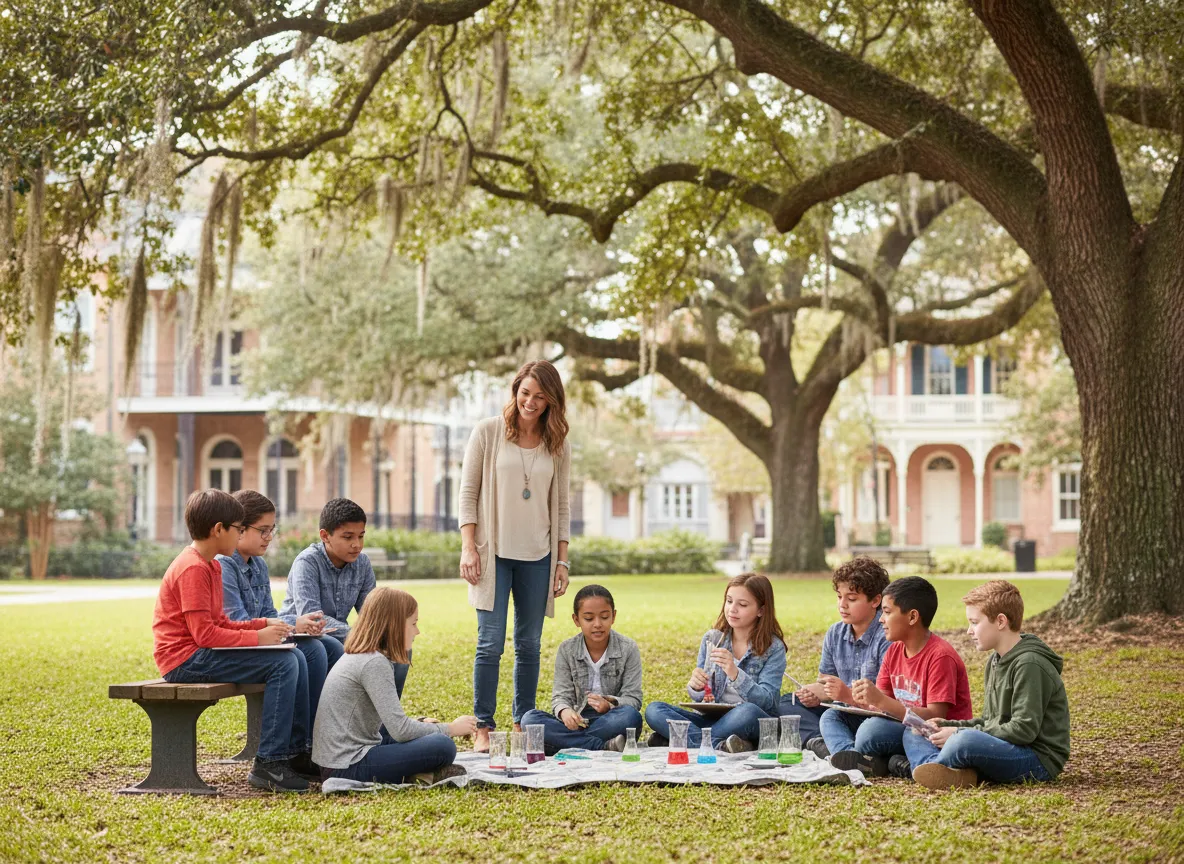
"More atelier than institution — rich in the arts, play, and deeply relational."
Montessori-inspired early years:
wonder before rigor.
In the early years, we draw deeply from Montessori philosophy — the belief that children learn best through hands-on exploration, purposeful movement, and work that is freely chosen within a prepared environment. We do not rush children into abstraction before they have had the chance to discover, touch, and build.
Our Seekers workshop (ages 5–11) is intentionally no-tech. Students engage with living books, natural materials, studio art, and the physical world around them. The early years are rich in unstructured play — not as a reward, but as a developmental necessity.
Each day includes intentional, unstructured play according to the development of the child to aid in their growth. Children are naturally curious. They want to build, explore, question, and understand the world around them — and we protect that impulse rigorously.
Students learn how to learn — not just what to memorize.
Across all three workshops — Seekers, Navigators, and Pathfinders — students pursue academic mastery in a self-directed model. Coaches do not stand at the front of the room and deliver information. Instead, they design the environment, set the standard, and then step back to coach.
Students work through core subjects at their own pace. They set goals at the beginning of each session, track their own progress, and develop the metacognitive awareness that traditional classrooms rarely have time to cultivate. Coaches guide — they do not lecture. Deep focus, no distractions.
The result is not a classroom of isolated individuals — it is a workshop of engaged, purposeful learners who genuinely know what they are working toward and why.
Each session begins with students naming what they intend to accomplish — building ownership before the work begins.
Students enter focused, uninterrupted work time. Coaches circulate, observe, and intervene only with questions — never answers.
At the end of each session, students assess their own progress honestly. Did they meet their goal? What needs attention tomorrow?
Students advance by demonstrating mastery — not by simply sitting long enough in a grade level. Progression is earned, not assumed.
"Our students learn in small, multi-age workshops where they pursue mastery in core academics while developing independence, confidence, and real-world skills."
Apogee SavannahStructured for deep work and delight.
The school day is structured to prioritize deep work in the morning, with more collaborative and artistic work in the afternoon. Exact start and end times vary by grade level and are shared during the admissions process.
Students work through core subjects at their own pace. Coaches guide — they do not lecture. Deep focus, no distractions.
- Set session goals
- Self-directed reading, writing, math
- Socratic dialogue & discussion
- Progress self-assessment
Each day has intentional, unstructured play according to the development of the child to aid in their growth.
- Unstructured free play
- Physical activity & outdoor time
- Peer conversation & friendship
- Restoration before afternoon work
Students collaborate, create, and learn through doing — entrepreneurship, workshop arts, and real-world skills applied to meaningful challenges.
- Project-based group work
- Studio arts & making
- Entrepreneurial projects
- One-on-one mentorship
We do not assign homework to allow for quality time with family and valuable learning alongside adults in the rhythms of family life. The day ends at school — evenings belong to families.
Real work.
Real stakes. Real learning.
Every afternoon at Apogee Savannah is devoted to projects, making, and the kind of applied learning that reveals whether academic knowledge has truly been absorbed. Students collaborate, create, and are asked to produce real work — not worksheets.
In the Seekers workshop, this looks like nature journals, artwork, and simple entrepreneurial ventures. In Navigators, it becomes project-based work tied to real problems — historical research, scientific experiments, and productive dialogue. In Pathfinders, students take on apprenticeships, capstone projects, and leadership opportunities that connect their education directly to the adult world.
Throughout all three workshops, the afternoon is governed by one principle: students must make something. Learning that produces nothing tangible rarely sticks.
Nature journals, studio art, introductory entrepreneurship, and hands-on workshop projects. Learning through making is central from day one.
Project-based group work, applied science, field study, and formal debate. Students learn to build arguments, test hypotheses, and present findings.
Apprenticeships, entrepreneurial ventures, capstone projects, and fine arts. Work is real, stakes are meaningful, and outcomes are genuinely student-owned.
Coaches, not lecturers.
The role of the adult in an Apogee workshop is fundamentally different from a traditional classroom teacher. Our coaches are selected for both subject mastery and moral imagination — people who genuinely invest in students as whole human beings.
"Each coach is committed to walking alongside students over time — asking good questions, offering thoughtful counsel, and pointing them toward a vision of adulthood that is rich in purpose and anchored in truth."
Thinking about education,
character, and childhood.
We write regularly about the ideas behind Apogee Savannah — what we believe about how children learn, what education is really for, and what families are discovering when they start asking deeper questions. If our philosophy resonates, the Notebook is the natural next step.
Read the Apogee Notebook →If this resonates,
come meet us.
The best way to understand Apogee Savannah is to experience it. Schedule a private conversation with our founder, or join an upcoming family meetup — no pressure, just a real discussion about what’s right for your family.
Average response time: one business day.
Stay in the loop.
Upcoming events, enrollment news, and updates from our community.